(Work in Progess)
Jim: An Australian Boy
The Story of Jim Wigley, the Painter
by Julian Wigley
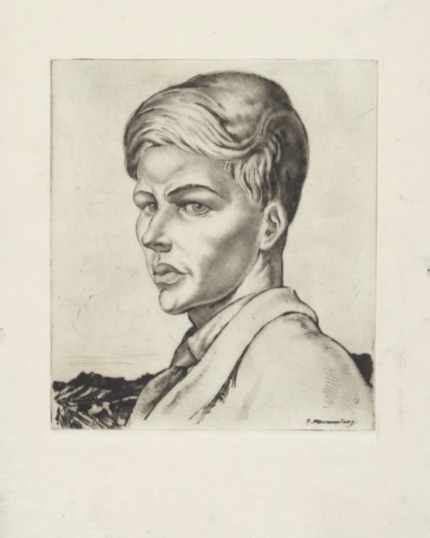
Jim: An Australian Boy, by F. Millward Grey, North Adelaide School of Fine Arts, c. 1935. Collection: National Gallery of Victoria.

I am interested in writing this story to explore why my father sabotaged his successes on so many occasions and to re-examine what I know about his life. Was his life shaped by what Don McLeod called his “scruples” in a letter written sometime in the late seventies or early eighties?
“Box 139 Port Headland 6721
15 July
Dear Jim,
In the past you have tended to allow your scruples to rob your opportunity. This might be an occasion by which you could if you had something suitable pick up a few dollars from the yokels who will bend anything to prevent people realising what they have done to the black fellas.
Things are much as usual here sometimes I think we are winning mostly, I know we aint (sic).
But at least we still worry the bastards
Yours Sincerely
D.W McLeod”
Don’s use of the word ‘scruples’ hinted at another Jim, one I suspected was always there, not the two Jims I alternately experienced—the drunk Jim or the sober Jim. I hope this story provides some insights into the man.
For those unaware of Don McLeod, he was a communist and activist who committed his life to the Strelley Mob in the Pilbara. He and Jim were comrades from 1957 until their deaths, coincidentally in 1999.
“My father – Jim – lived in a suitcase under my grandmother’s cottage in Warrandyte. When he was real, he lived up the hill with Mum and me, occasionally.”
— From Catch Him By His Name
Over the years, I tracked my father’s life as his paintings changed on my grandmother’s wall: a pastel drawing on butcher’s paper, dated 1945, drawn on the banks of the Daly River in the Northern Territory, showing two men accompanied by three dogs, walking in single file, holding a stick between them – ‘Blind Man.’ A large oil painting was added a few years later, painted in the 1950s, of a barmaid leaning on the counter of the Grey Eagle Pub in Whitechapel, London, to be replaced a decade later by a streetscape of Glebe terraces in Sydney, NSW.
My grandmother provided snippets of my occasional father’s life as I sat beside her bed and she read his letters. I looked at his pictograms of exotic places sketched in the margins. Rusty, my dog, also spent much time at my grandmother’s side. Rusty was half dingo, half kelpie, with half a tail, the missing half lost under the school bus. Each morning and evening, Rusty would chase the school bus, snapping at the front wheels until he could no longer keep up. I say Rusty was my dog, but Jim’s letters to Dove always asked about Rusty, rarely about Mum and me.
As I grew older, I began to find him in the pages of art books—sometimes as a footnote, a brief sentence, or a mention at the tail end of a paragraph about the Social Realists and their art. More recently, others have written about his life and work: Sheridan Palmer and Jane Eckett in — James Vandeluer Wigley (1917–1999), and Inge Kral and Darren Jorgensen — James Wigley and the Strelley Mob: Social Realist Painting in an Aboriginal Community.
At the age of eighty, and with my parents long dead, I finally found the courage to listen to my father, Jim, recount his life to Barbara Blackman when he was seventy. I listened for the things left unsaid, hoping to fill the gaps and silent spaces of his life while also searching for answers to my own story, which I am writing.
This short book, however, is about Jim—an Australian boy—whose journey stretches from the quiet streets of Adelaide to the bohemia of Warrandyte, post-war Europe, and the deserts of northern Australia.
Jim: An Australian Boy forms part of a trilogy drawn from Red Heart No. 3: Catch Him by His Name, a personal and historical narrative of family, art, and architecture. The other books are:
Malahide: A House of Many Homes tells Mum’s story, from my Adelaide parents’ move to the bohemia of Warrandyte in the 1940s to Mum’s boarding house in inner-city Richmond during the 1950s and 1960s.
Wigley’s Waterhole: Family, Country and the Politics of Shelter in Central Australia is my personal story of living and working in northern Australia from the 1970s onwards.
Notes
©️ Julian Wigley 2024 and all images unless stated otherwise.
Request: If you are the owner of Jim’s last painting, ‘Snapshot, Darwin,’ purchased from the Niagara Galleries, Melbourne, would you please get in contact? I would like a colour photo for publishing purposes.